GDP—Gross Domestic Product—is the single most important number in global economics, yet it is also one of the most misunderstood. Every quarter, headlines scream about growth rates, recessions, and recoveries based on this one metric. Governments win or lose elections on it, central banks set policy around it, and investors make billions betting on it. But what does GDP actually measure, what does it miss, and why should anyone beyond economists care? This article cuts through the jargon to reveal GDP’s true role in understanding—and navigating—the global economy.
Historical Context & Evolution
The concept was born during the Great Depression when economists needed a way to measure economic activity systematically. Simon Kuznets, its intellectual father, created the framework in the 1930s to help the US government understand the depression’s depth. By World War II, GDP became the standard for measuring national output and planning wartime production.
After the war, it spread worldwide as newly independent nations needed tools to track development. The United Nations standardized its calculation in the 1950s, making cross-country comparisons possible for the first time. Over decades, the methodology evolved to include services and technology, but its core purpose—measuring market-based production—has remained unchanged.
Current Global Landscape
Today GDP comes in three main forms: nominal (current prices), real (inflation-adjusted), and per capita (divided by population). Global GDP exceeds $100 trillion annually, with the US, China, and the European Union accounting for over half. Emerging economies now drive most growth, while advanced economies struggle to maintain 2-3 percent annual expansion.
The calculation follows a simple formula: GDP = Consumption + Investment + Government Spending + (Exports – Imports). Each component tells a different story about economic health—consumer confidence, business optimism, fiscal policy, and trade competitiveness. Yet the aggregate number dominates headlines, often obscuring important divergences within the data.
Key Drivers and Mechanics
Four forces make GDP tick. Consumption, usually 60-70 percent of GDP in advanced economies, reflects household confidence and income levels. Investment—business capital spending and residential construction—signals future growth prospects and responds sharply to interest rates and policy signals.
Government spending provides stability but can distort signals when it grows faster than the private sector. Net exports act as a wildcard: trade surpluses boost GDP, while deficits drag it down. The mechanics are deceptively simple, but the interpretation requires understanding local context—China’s investment-heavy model looks very different from the US consumption-driven economy.
Regional Impact
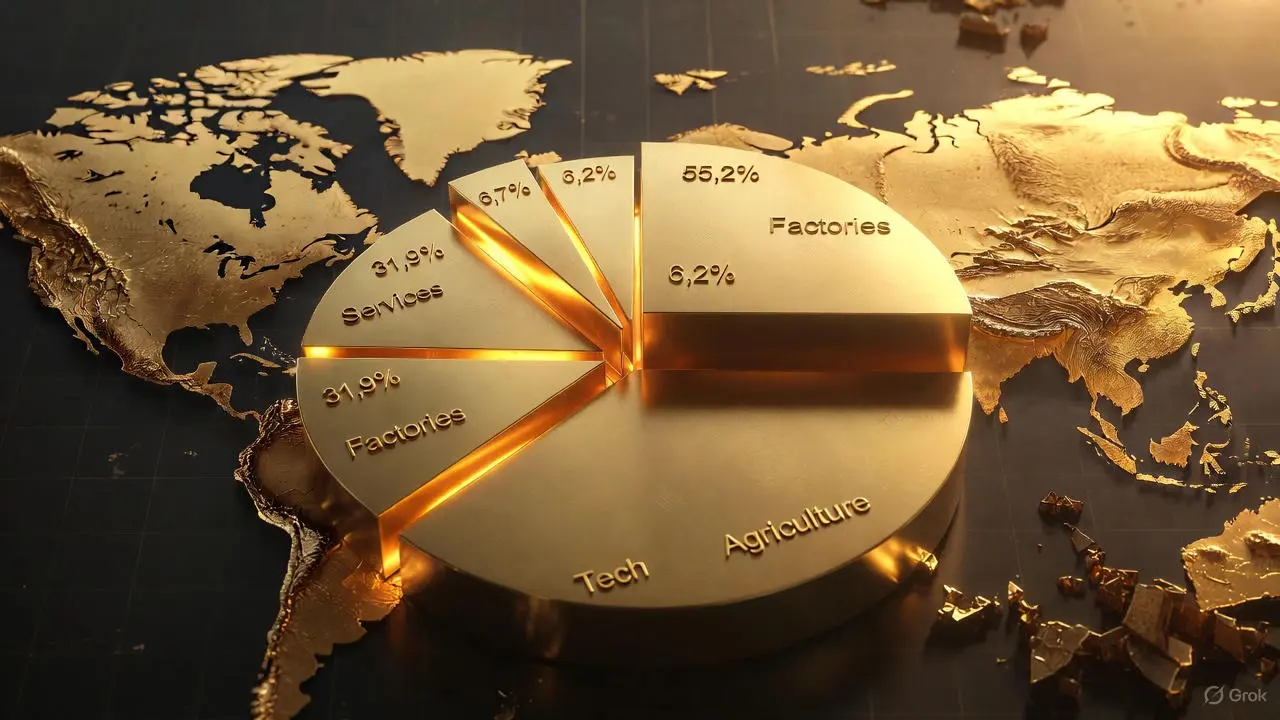
GDP patterns vary dramatically by region. Advanced economies like the US, Japan, and Germany rely heavily on services and technology, with consumption driving most growth. Emerging Asia—led by China and India—leans on manufacturing, exports, and infrastructure investment for rapid expansion.
Latin America and Africa remain commodity-dependent, making their GDP volatile when global prices swing. Europe benefits from deep integration but suffers when any major member slows. These differences create opportunities for investors who understand regional drivers and pitfalls for those who apply universal rules indiscriminately.
Risks and Challenges
GDP has well-known blind spots. It counts pollution cleanup as positive growth while ignoring environmental destruction. It measures hospital visits but not health outcomes, divorce settlements but not family stability. Inequality disappears in the aggregate number, and unpaid work—childcare, eldercare, volunteering—remains invisible.
Another challenge is manipulation. Governments sometimes accelerate spending or delay imports to boost quarterly numbers. Shadow economies in many developing nations push actual activity far above official figures. Finally, GDP growth can mask underlying weakness—Japan’s “lost decades” showed positive GDP while living standards stagnated.
Future Outlook
GDP will evolve but not disappear. Pressure to incorporate environmental costs, inequality measures, and digital economy activity will force methodological updates. Alternative metrics—Green GDP, Inclusive Wealth Index, or Human Development Index—may gain prominence for policy but struggle to replace GDP’s simplicity and universality.
Technology will make real-time GDP estimation possible using satellite imagery, credit card data, and mobile phone usage. Emerging economies will demand greater voice in defining what gets measured and how. The core challenge remains: balancing comprehensive measurement with practical usability for decision-makers.
Practical Implications for Investors and Businesses
GDP remains the best single gauge of economic momentum. Positive surprises in quarterly data often trigger stock rallies and currency strength; disappointments spark sell-offs. Investors should watch the components as closely as the headline—strong consumption signals consumer confidence, while rising investment points to multi-year growth.
Businesses use GDP forecasts to time expansion, hiring, and inventory decisions. Countries consistently above 3 percent growth attract foreign investment; those stuck below 2 percent face credit downgrades. Understanding local GDP drivers helps companies avoid mistaking national averages for regional realities.
Conclusion
GDP is an imperfect tool for a complex world, but it remains indispensable. No other single number comes close to capturing the breadth and momentum of economic activity across 190-plus countries. Its limitations are real but do not negate its power to guide decisions, allocate resources, and measure progress. Those who understand both what GDP reveals and what it conceals will make better choices in business, policy, and investment than those who ignore it entirely.
FAQ
Q. What does GDP actually measure?
A. The total value of all goods and services produced within a country’s borders over a specific period, usually a quarter or year.
Q. Why do economists use real GDP instead of nominal?
A. Real GDP adjusts for inflation, showing true changes in output rather than price level movements.
Q. Can a country have high GDP growth but low living standards?
A. Yes—when growth concentrates in a few hands or destroys environmental capital that future generations need.
Q. How reliable are official GDP numbers?
A. Generally reliable in advanced economies, less so in emerging markets where shadow economies and data manipulation occur.
Q. Will GDP become obsolete as we measure progress differently?
A. Unlikely. Its simplicity and universality make it hard to replace, though it will likely be supplemented by other metrics.
Q. Why does GDP matter to individual investors?
A. It drives central bank policy, corporate earnings, and market sentiment—everything that moves portfolios.